

+ The 1979 Book of Common Prayer, an online edition
+ Most recent available Sunday's service program and weekly bulletin (.pdf)

How We Worship
Sunday Services: Why We Do What We Do
The principal worship service in the Episcopal Church and here at St Martha’s is the Holy Eucharist (Communion)—according to the Book of Common Prayer, “the sacrament commanded by Christ for the continual remembrance of his life, death, and resurrection, until his coming again.”
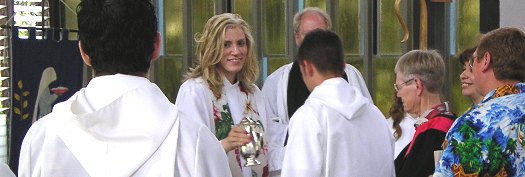
One thing you’ll notice is that all baptized Christians are welcome to receive Communion in the Episcopal Church—not because we take the Eucharist lightly, but because we take Baptism seriously.
The typical Episcopal Church service (about an hour long) has a lot of “church calisthenics” (kneeling, sitting, standing, etc.). We stand and sing, kneel in prayer and sit while listening to the Word of God. Don’t worry if you don't know what to do (and there really is no right nor wrong way of doing things)—the small italicized print in the Book of Common Prayer suggests what to do next in the service. There are also times during the service when you will see people cross themselves, bow slightly, and genuflect when entering or leaving a row of pews. Some people prefer to kneel during a prayer and others stand.
As a whole, you’ll find that the Episcopal Church has a great respect for traditional music and practices. That’s not to say the Episcopal Church isn't open to new and exciting worship styles. It is.
Rite I, Rite II — What..?
When you come to an Episcopal Church on Sunday morning, you’ll read somewhere on the first line of the bulletin that it’s a Rite I or Rite II service. Rite I services have a Shakespearean feel, using older English (thees and thous) and rhythmically flowing prayers. You’re probably already familiar with it: anytime you see a church service, or wedding, or hear a prayer in a motion picture or television program, you’re likely hearing portions from the Episcopal 1928 Rites. Directly based on much earlier Rites, Rite I (slightly modified in the 1979 Book of Common Prayer) became standard in 1928 and is still used in many parishes today, often for early morning services.
Inspired from Rite I, Rite II (issued in 1979) uses modern English and can be considered a little less formal. It’s now the more commonly used service in the Episcopal Church.
The typical Rite II service — Why we do what we do
It would take an entire book to explain all the nuances of an Episcopal service, referencing what each person says or does, or trying to explain what the historical or spiritual significance is of each little part. Here, we’ll just touch on the highlights. Comparing the service to a play in which we all have a part; let’s run through a typical Rite II service, breaking the service into two major acts…
Act I — Liturgy of the Word
Processional — The processional hymn starts the service. The cross leads the procession, followed by those assisting in the service. The celebrant (the Priest) always brings up the end of the procession. We do this to set the stage for this special event.
Collect — The celebrant greets everyone and leads the first prayer. The collect is the prayer that sets the motif for the service. If you listen carefully, this opening prayer often summarizes the theme of the readings, sermon, and often even the music.
Readings — There are usually three readings in the service. The first reading is from the Old Testament in the Holy Bible. The second reading is from one of the letters in the New Testament. The third reading, read only by either the celebrant or a deacon, is called The Gospel and comes from the Book of Matthew, Mark, Luke or John in the New Testament.
Sermon — The celebrant shares stories, interprets the readings for the day, and otherwise gives an inspired talk. (Episcopal clergy pride themselves in the ability to give good sermons, which last between 10 and 20 minutes on the average.)
Creed — All stand and profess their faith. Used continuously since it was accepted around 325 A.D., the ancient Nicene Creed is the most universally accepted profession of the Christian faith. It encompasses the key elements all Episcopalians believe.
Prayers of the People — These prayers are for the Church, for the world, for our country’s leaders, for our church leaders, for the sick, for families (you’ll notice the parish’s prayer list in the bulletin)… Just about everyone falls under one category or another. At every service prayers are offered to God for these people, in thanksgiving or seeking God’s blessing.
Confession and Absolution — Here in the service we have the opportunity to kneel before God and confess how we each have fallen short of where God would like us to be. In other words, before we can get on with the celebration of the rest of the service, we ask God’s forgiveness.
The Peace — Before moving on to Act II and taking part in the Liturgy of the Eucharist, all are invited to “make some sign of peace” with others in the congregation (usually a handshake or hug). The idea here is to make peace with friends and family before coming before the Lord’s table.
Anthem — This is the music sung by the choir before the gifts (the Communion bread and wine, etc.) are brought up to the altar. The Anthem is sung to focus everyone towards the front for the second half of the service.
Act II — Liturgy of the Eucharist
This is clearly the second half of the service. The celebrant and assistants move up to the altar. All attention moves away from the choir and the readers. All attention is on God and welcoming Christ into the service to connect with us each in a very special, personal, way.
Eucharistic Prayers — The series of prayer in preparation of taking Communion. In Greek, “Eucharist” literally means “good gift” or “thanksgiving.” You’ll read in your bulletin that we’re doing form A, B, C, or D. You see, not every worship service is exactly the same, nor should they be…
Some services are joyful, others services are powerful stressing how, perhaps, we have fallen short of “being the best we can be” and by turning to God for His love and forgiveness. Services which use form A tend to be more penitent. A is often used during Lent. Services which use form B tend to be more joyful. Weddings, for example, will often use form B. Some think of form C services as outdoors, woodsy and participatory. Form C speaks strongly of the beauty of nature and is the version which has the most interaction between the celebrant and everyone else. Form D speaks of covenant, and God’s promise of bringing salvation to us through Christ.
Communion — In the Episcopal Church, everyone may go up for a Communion blessing, and every baptized person may receive the bread and wine. After receiving communion, it’s customary to kneel or sit quietly to reflect on God, Christ and the Holy Spirit which has been made known through the service.
We Episcopalians feel that Communion, the Eucharist, these “good gifts,” are very holy. Trying to explain it here beyond this is difficult—suffice to say there’s much mystery and feels very real.
Prayers of Thanksgiving — Often called the Postcommunion prayers. After all have received Communion, all are invited to kneel and thank God for His blessings and presence among us.
Final Blessing — The celebrant joyfully blesses everyone in the name of God before all go out into the world to “do good deeds, think good thoughts, and be good deed doers” (words borrowed from the Wizard of Oz, but not in jest).
Recession — Sometimes called the closing, or closing hymn. Just as there is music at the start of the service to pull us all into the happenings, there is music at the end to inspire us to go out into the world in the name of Christ.
The church service has come to a close, but we Episcopalians believe that the simple act of fellowship is important too. Now that we’ve gone “out into the world in the name of Christ,” you’ll find that many stay for a while: to have a cup of coffee or a snack, to share a story or a laugh, catch up on the latest “news” (uh, what was that part about “think good thoughts?”) …To simply linger and enjoy the company of each other.

Originally written by Maria Hoshaw and Josh English
Peek Through the Window of the Episcopal Church
With apologies, torn asunder then edited by St. Martha’s gargoyle